

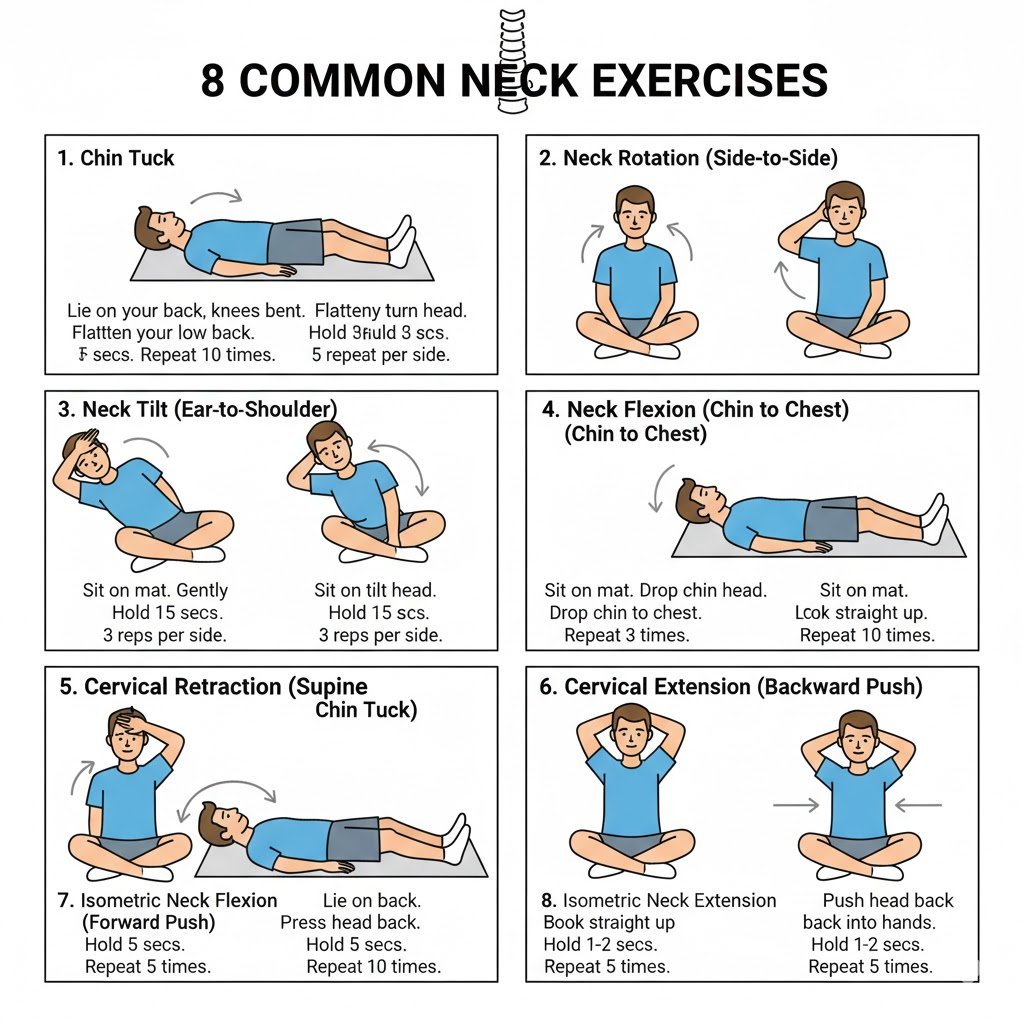
Gentle Neck Exercises
These exercises help reduce stiffness and improve the range of motion in your neck. Remember to do them slowly and gently, only going as far as feels comfortable.
Neck Exercises (8 Common Movements)
- Chin Tuck
This helps strengthen the small muscles in the front of your neck and improves your head posture.
- How to do it: Sit or stand tall. Gently pull your chin straight back as if you are making a double chin. Keep your eyes level and look straight ahead.
- Hold: Hold for 3-5 seconds.
- Repeat: Do 10 times.
- Neck Rotation (Looking Side-to-Side)
This improves your ability to turn your head to look over your shoulder.
- How to do it: Sit or stand tall. Slowly turn your head to the right as far as you comfortably can (until you feel a gentle stretch).
- Hold: Hold for 3 seconds.
- Repeat: Slowly turn back to the center, then turn to the left. Repeat 5 times on each side.
- Neck Tilt (Ear to Shoulder)
This stretches the side of your neck and upper shoulder muscles.
- How to do it: Sit or stand tall. Gently tilt your right ear toward your right shoulder. Do not lift your shoulder. Go only as far as you feel a gentle stretch.
- Hold: Hold for 15 seconds.
- Repeat: Slowly bring your head up, then tilt your left ear toward your left shoulder. Repeat 3 times on each side.
- Neck Flexion (Chin to Chest)
This stretches the muscles at the back of your neck.
- How to do it: Sit or stand tall. Slowly drop your chin toward your chest. You should feel a gentle stretch in the back of your neck.
- Hold: Hold for 15 seconds.
- Repeat: Slowly bring your head back up. Repeat 3 times.
- McKenzie Cervical Retraction (Supine Chin Tuck)
This is a specific McKenzie method exercise done lying down to help bring the head back into alignment.
- How to do it: Lie on your back with your knees bent and feet flat. Keeping your eyes level, press the back of your head gently into the floor/bed, making a chin tuck.
- Hold: Hold for 5 seconds.
- Repeat: Relax and repeat 10 times.
- McKenzie Cervical Extension (Looking Up)
This McKenzie exercise is often used to relieve pain that moves down the arm.
- How to do it: Sit or stand tall. Slowly and fully look straight up toward the ceiling.
- Hold: Hold the position for just 1-2 seconds.
- Repeat: Come back to the starting position and repeat this 10 times.
- Isometric Neck Flexion (Forward Push)
This is a strengthening exercise where you push against your hand without moving your head.
- How to do it: Place the palm of your hand on your forehead. Gently push your head forward into your hand, but use your neck muscles to stop your head from moving.
- Hold: Hold the gentle push for 5 seconds.
- Repeat: Relax and repeat 5 times.
- Isometric Neck Extension (Backward Push)
This strengthens the muscles at the back of your neck.
- How to do it: Place both hands clasped behind the back of your head. Gently push your head backward into your hands, but use your neck muscles to stop your head from moving.
- Hold: Hold the gentle push for 5 seconds.
- Repeat: Relax and repeat 5 times.
Sources:
- Clinical Practice Guidelines: Principles derived from standards set by bodies like the American Physical Therapy Association (APTA) for cervical spine pain management.
- Mechanical Diagnosis and Therapy (MDT): Protocols for exercises #5 (Cervical Retraction) and #6 (Cervical Extension), established by the McKenzie Institute International.
- Principles of Isometrics: Standard resistance principles used in musculoskeletal rehabilitation for exercises #7 and #8.