
Back, Core, and Stabilization Exercises (8 Movements)
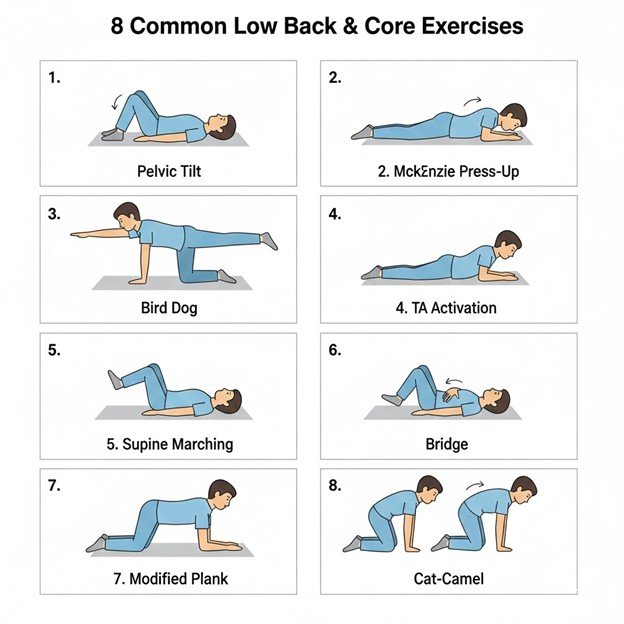
- Pelvic Tilt
This is a great starting point for finding your core muscles and relaxing your low back.
- How to do it: Lie on your back with your knees bent and feet flat. Gently flatten your low back against the floor by tightening your stomach muscles and slightly rotating your pelvis.
- Hold: Hold the position for 5 seconds.
- Repeat: Repeat 10 times.
- McKenzie Press-Up (Extension in Lying)
This McKenzie exercise helps relieve certain types of low back pain by moving the spine backward.
- How to do it: Lie on your stomach. Place your elbows directly under your shoulders and prop yourself up (like the Sphinx pose), keeping your hips and pelvis touching the floor. Let your low back sag naturally.
- Hold: Hold for 10-15 seconds.
- Repeat: Repeat 10 times. (If this feels good, you can press up onto your hands, like the top of a push-up).
- Bird Dog
This exercise strengthens the muscles that stabilize your spine and improves balance.
- How to do it: Start on your hands and knees (tabletop position). Keep your back flat like a table. Slowly extend your right arm straight forward and your left leg straight back. Keep your hips level—don’t let your back twist.
- Hold: Hold for 5 seconds.
- Repeat: Slowly return to the start, then switch sides (left arm, right leg). Repeat 10 times on each side.
- Transverse Abdominis (TA) Activation
This exercise targets a deep core muscle important for spinal stability.
- How to do it: Lie on your back with your knees bent. Place your fingers just inside your hip bones. Gently pull your belly button in toward your spine, without moving your back or pelvis. You should feel the muscle tighten under your fingers.
- Hold: Hold for 10 seconds while breathing normally.
- Repeat: Repeat 10 times.
- Supine Marching
A simple movement that tests and builds your core endurance while lying down.
- How to do it: Lie on your back with your knees bent and core tight (like the Pelvic Tilt). Slowly lift one foot just a few inches off the floor, like you are marching in place.
- Move: Lower that leg and then lift the other leg.
- Repeat: Repeat 10 times on each side, moving slowly and making sure your back does not arch.
- Bridge
This strengthens your glutes (buttock muscles) and hamstrings, which are key supporters of the low back.
- How to do it: Lie on your back with your knees bent and feet flat, hip-width apart. Squeeze your butt muscles and push your hips up toward the ceiling until your body forms a straight line from your shoulders to your knees.
- Hold: Hold the top position for 5 seconds.
- Repeat: Slowly lower your hips back down. Repeat 10 times.
- Modified Plank (Knees Down)
This builds core strength without putting too much strain on the low back.
- How to do it: Lower yourself onto your forearms and extend your legs back so you are supported on your knees. Keep your body in a straight line from your head to your knees. Don’t let your hips sag!
- Hold: Hold this position for 30 seconds (or as long as you can keep a flat back).
- Repeat: Repeat 3 times.
- Cat-Camel (or Cat-Cow)
This movement helps improve flexibility in the spine.
- How to do it: Start on your hands and knees. Cat: Gently round your back up toward the ceiling, tucking your chin and tailbone (like an angry cat). Camel/Cow: Then, slowly drop your stomach toward the floor and lift your head and tailbone slightly (like a cow).
- Move: Move slowly and gently between these two positions.
- Repeat: Repeat 10 times.
Sources:
- Clinical Practice Guidelines: Look for guidelines from the American Physical Therapy Association (APTA) for Lumbar Spine and Sacroiliac Joint Dysfunction. These documents summarize evidence-based treatment.
- Major University Health Systems: Sources like the Mayo Clinic or Cleveland Clinic often publish detailed, patient-friendly protocols for low back stabilization and pain management.